The Woodcutter and the Heavenly Maiden: Motifs and Meanings
The Tale of the Woodcutter and the Heavenly Maiden: Motifs and Interpretations
If you spend any time exploring Korean traditional culture, you will inevitably encounter the Seonnyeo (선녀). Often depicted in elegant, flowing robes, these celestial maidens are recurring figures in murals, folk paintings, and historical dramas. But to truly understand where they come from—and how they have embedded themselves into the Korean imagination—you have to look at the quintessential folktale: The Tale of the Woodcutter and the Heavenly Maiden.
It is a story that exists in the cultural bedrock of Korea. While the narrative might feel like a simple myth at first glance, it is actually a complex tapestry of traditional values, nature-based symbolism, and shifting social perspectives.
The Core Narrative: A Celestial Encounter
The story begins in a deep, lush forest. A hardworking, humble woodcutter is going about his daily labor when he encounters a deer being chased by a hunter. Out of compassion, the woodcutter hides the deer. In gratitude, the deer reveals a secret: a group of Seonnyeo (heavenly maidens) descend from the sky to bathe in a pond in the mountains. If the woodcutter manages to steal one of their feathered garments while they bathe, the maiden will be unable to return to the heavens and will be forced to marry him.
The woodcutter follows the advice, steals the garment of the youngest maiden, and the two eventually marry and have children. Years pass, and the woodcutter eventually reveals the location of the hidden garment to his wife. She immediately puts it on and ascends to the heavens with their children in tow. The woodcutter is left behind, eventually attempting to follow them by grabbing hold of a bucket lowered from the sky, only to fall back to earth, becoming a rooster—or, in some versions, simply remaining a man who waits for a reunion that never comes.

Separating the Traditional from the Simplified
For many international readers, the version of this story they encounter is often a sanitized, modern adaptation. In these simplified retellings, the tale is frequently presented as a straightforward romance or a whimsical “boy meets girl” fantasy. The darker, more coercive elements—specifically the theft of the garment as a violation of the Seonnyeo’s agency—are often smoothed over to make the story more palatable for children.
However, the traditional Korean oral tradition is far more nuanced. In the older versions, the focus is less on a “happily ever after” and more on the tension between the mortal world and the celestial realm. The woodcutter is not necessarily a romantic hero; he is a man interacting with forces beyond his station.
When you see the Seonnyeo referenced in modern Korean culture today—perhaps on a restaurant sign, in a piece of Minhwa (folk art), or as a character in a webtoon—it is rarely a direct reference to the “romance” of the woodcutter. Instead, it is a reference to the archetype of the otherworldly, elegant, and ethereal maiden. Understanding this distinction is key: the folktale is the foundation, but the Seonnyeo as a symbol has moved beyond the story’s plot points.
Nature Motifs: The Pond and the Feathered Robe
In Korean folklore, the natural landscape is rarely just a backdrop; it is a character in its own right. The bathing pond, often hidden in a secluded, mountainous area, represents the boundary between the mundane and the transcendent.
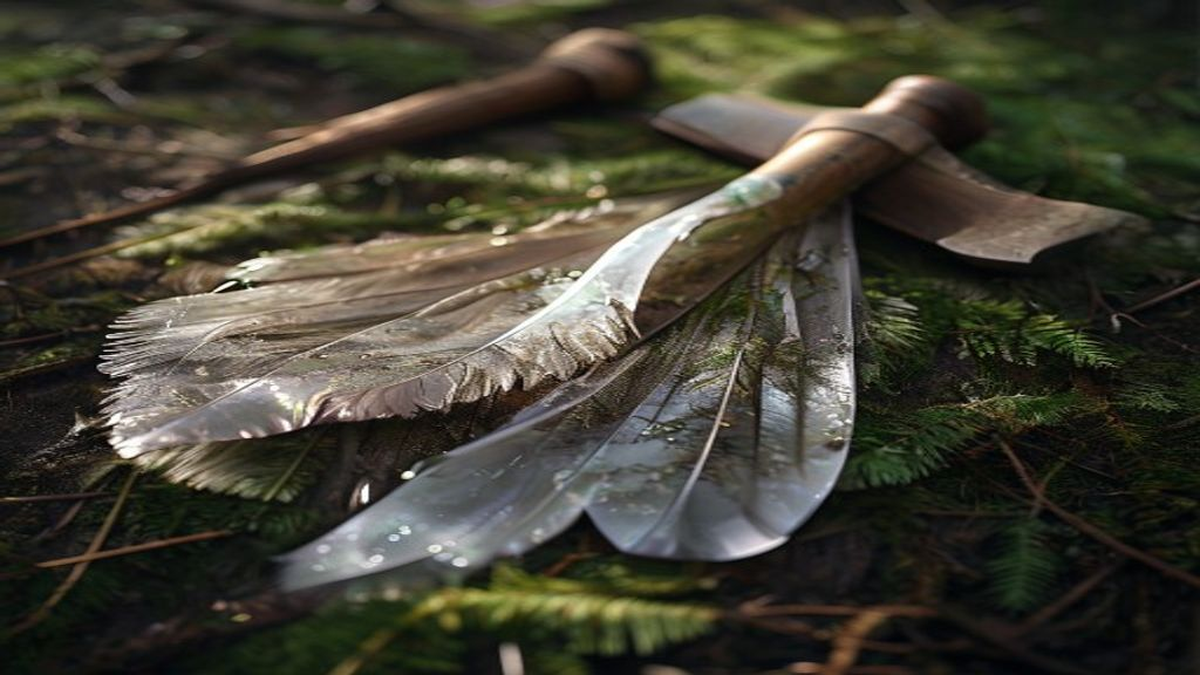
The Seonnyeo’s feathered robe is the most crucial motif in the tale. It functions as a symbol of her autonomy and her connection to the heavens. By taking the robe, the woodcutter is not just taking an article of clothing; he is physically grounding a celestial being. This motif of the “stolen garment” is found in folklore across the globe, but in the Korean context, it emphasizes the importance of Gyeong-gwan (scenery or landscape). The heavens are not abstract; they are a place one can reach if one has the right connection or the right vehicle.
When you walk through a Korean mountain temple or visit a national park, look for the small, clear pools or streams. You will often hear locals jokingly remark that a Seonnyeo might have bathed there. This is a common cultural shorthand—a way of expressing that a place is pristine, untouched, and possesses a divine beauty. It is a lighthearted way of bestowing value upon nature.
Gender Dynamics and the Celestial Order
The gender dynamics of the tale are perhaps the most debated element of the story. In a historical context, the Seonnyeo represents an untouchable ideal. She is not a human woman; she is a celestial entity. Because of this, the woodcutter’s attempt to claim her represents the human desire to possess something that is inherently outside the realm of human ownership.
Modern interpretations often focus on the woodcutter’s actions as an act of theft, highlighting the power imbalance. However, looking at the story through the lens of traditional folklore, the focus is often on the Gyeol-mal (conclusion or destiny). The woodcutter’s failure—or his transformation into a rooster that crows at the dawn—serves as a cautionary reminder of the limitations of the mortal experience.
In everyday conversation, you might hear the term Seonnyeo used to describe someone who seems “out of place” in a modern, gritty setting, or someone who is exceptionally graceful or ethereal. It is not necessarily a political statement, but rather a way to describe a specific, almost unearthly aesthetic. You might hear someone say of a traditional dancer or a particularly graceful performer, “She has the air of a Seonnyeo.” This recognizes the aesthetic lineage of the figure without needing to re-litigate the woodcutter’s problematic behavior.
Cultural Recognition in Daily Life
If you live or travel in Korea, you will find these motifs appearing in surprising places. You will see Seonnyeo painted on the eaves of Hanok (traditional houses) or depicted on the packaging of traditional snacks. They are symbols of grace, light, and the connection between the sky and the earth.
When you see these images, you are seeing the result of centuries of storytelling. You don’t need to treat the story as a historical document to appreciate why it persists. It persists because the image of the celestial maiden is a beautiful, evocative anchor for Korean identity. Whether she is appearing in a K-drama as a mysterious figure from the past or being used as a shorthand for beauty in a poem, the Seonnyeo remains a constant presence.
The next time you see a depiction of a woman in flowing, colorful robes floating among the clouds in a piece of Korean design, you’ll know the history behind the image. You’ll recognize the Seonnyeo not just as a fairy-tale character, but as a bridge to a version of Korea where the mountains were homes to the divine and the clouds were pathways for the otherworldly.
It is a modest, persistent thread in the tapestry of Korean life. There is no grand secret to be unlocked or deep moral to be implemented, just the simple, enduring beauty of a story that has been told from the mountain valleys to the modern city streets for generations. That, in itself, is enough.