The Story of Shim Cheong: Understanding Filial Piety in Korea

The Story of Shim Cheong: Filial Piety and Its Complex Legacy
If you have spent any time observing family dynamics in Korea, you have likely encountered the concept of hyo (filial piety). It is a term that surfaces during holiday gatherings, in television dramas, and in the quiet, unspoken expectations that govern how children treat their aging parents. To understand the root of this value, one must look at the most famous of all Korean folktales: The Story of Shim Cheong.
It is a tale that every Korean child grows up knowing, a narrative bedrock that helps explain why the parent-child bond is viewed not just as a biological reality, but as a moral imperative.
The Tale of the Devoted Daughter
The story begins with a blind man named Shim Hak-gyu, who lives in deep poverty with his young daughter, Shim Cheong. Despite their dire circumstances, Cheong is described as a paragon of virtue. She spends her days begging for food to feed her father and caring for him with a devotion that leaves no room for her own needs.
The turning point of the story centers on a desperate desire: the father wishes to regain his sight. He hears from a monk that if he makes an offering of three hundred bags of rice to the Buddha, his eyes will be opened. Lacking any way to acquire such wealth, the father is heartbroken. When Shim Cheong discovers the cause of his distress, she makes an unthinkable choice. She sells herself to a group of sailors who are looking for a maiden to sacrifice to the Dragon King of the Sea in exchange for safe passage.
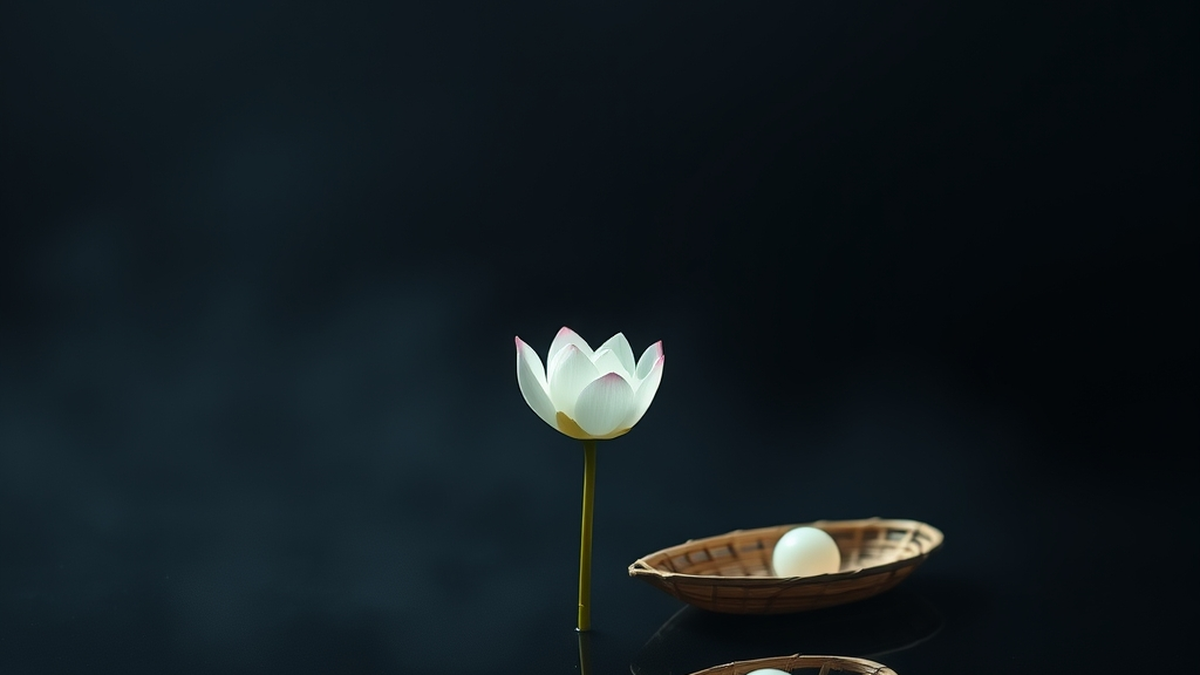
Shim Cheong believes that by sacrificing her life, she can provide the merit needed to restore her father’s sight. She jumps into the turbulent sea, but the story does not end in tragedy. Impressed by her extreme filial piety, the Dragon King restores her to the world of the living. She is returned to her father on a giant lotus flower, and upon their reunion, the shock and joy are so profound that the father’s eyes miraculously open.
Understanding Hyo: Beyond a Simple Duty
To look at Shim Cheong’s sacrifice solely through the lens of individual agency or autonomy is to miss the cultural landscape that the story inhabits. In Korean society, hyo is not seen as a burden forced upon children; it is framed as the foundational ethics of a human being.
Hyo (filial piety) implies a reciprocal, lifelong relationship. The logic of the folktale suggests that the life a parent gives a child is an infinite debt. In daily life, this manifests in ways that are both profound and mundane. You might see it when a young professional, even after moving out, makes a weekly trip back home just to help their parents organize a complicated digital banking app or to share a meal.
It is common to hear Koreans talk about “paying back” the love of their parents. This does not necessarily mean monetary compensation, but rather a constant, conscious effort to ensure the parents feel respected and cared for. If you find yourself in a Korean home, you might notice the eldest child or the most successful sibling taking charge of health check-up appointments or travel arrangements for the parents. This is not viewed as a chore, but as an expression of hyo. It is the modern-day iteration of Shim Cheong’s rice bags—an acknowledgment that the child’s stability is built upon the sacrifices of the parents.
The Cultural Nuance of Self-Sacrifice
While the dramatic jump into the sea is a mythic exaggeration, the core impulse—the idea that the needs of the family unit can supersede the desires of the individual—is a recognized rhythm in Korean life.
Consider the way decisions are often communicated within a Korean family. A child might take a job they are less passionate about because it is more stable, effectively choosing a path that ensures they can support their parents in the future. In the context of Korean culture, this is rarely framed as a “loss of self.” Instead, it is viewed as a mature, responsible choice. To be a “good son” or a “good daughter” is a highly respected social status, carrying a sense of pride that often balances out the personal sacrifices made along the way.
When you see a television show or read a news story about an adult child moving back home to care for an elderly parent, the framing is almost always one of nobility. You will not find the Western focus on “independence” as the ultimate goal of adulthood. In Korea, the goal is often “interdependence”—the ability to hold the family together as the roles naturally shift over time.
Recognizing the Legacy in Daily Life
Once you are familiar with the story of Shim Cheong, the concept of hyo becomes much easier to spot in real-world interactions. You might notice it during Chuseok (the harvest festival) or Seollal (Lunar New Year), when families travel across the country to bow to their elders and present them with gifts of health supplements or cash.
There is also a lighthearted, social side to this value. You might see it in the way a younger person waits for the oldest person at the table to pick up their chopsticks before they begin eating. Or, you might witness a younger employee carefully pouring a drink for their senior colleague, holding their own wrist with their other hand as a gesture of deference. These are micro-expressions of the same value system found in the story of the blind father and his daughter. It is about acknowledging the hierarchy of experience and the debt of care.
However, the legacy is not without its friction. In contemporary society, the tension between traditional expectations of hyo and the realities of modern urban life is a frequent topic of debate. How does one maintain such a high standard of filial piety when working long hours in a competitive city? How do adult children manage to care for aging parents while balancing their own careers?
These are questions that many Koreans grapple with in silence. The story of Shim Cheong remains relevant precisely because it highlights this inherent tension. It asks: How far are we willing to go for those who gave us life?
A Closing Note
The story of Shim Cheong is more than just a fable about a daughter’s sacrifice. It serves as a lens through which one can view the intricate, often beautiful, and sometimes demanding web of relationships that defines Korean family life.
Whether it is in the act of preparing a favorite meal for a parent, managing their medical appointments, or simply sitting in silence together after a long day, the echoes of the lotus flower and the miracle at the sea are never truly gone. They are woven into the fabric of daily interactions, serving as a reminder that in this culture, the identity of the individual is inextricably linked to the love and duty they owe to those who came before them. When you see this dynamic in action, you are witnessing a value that has been a defining feature of Korean life for centuries, constantly being adapted to fit the complexities of the modern world.