The Legend of the Magpie Bridge: Exploring Chilseok Traditions
The Legend of the Magpie Bridge: Chilseok Traditions
As the sweltering heat of late summer begins to crest in Korea, the sky often takes on a particularly crisp, clear quality. According to Korean folklore, this atmospheric shift is no coincidence. It is the celestial backdrop for a long-awaited reunion. This is the time of Chilseok (칠석), a traditional festival falling on the seventh day of the seventh lunar month, which serves as a cultural anchor for themes of devotion, seasonal transition, and the delicate balance between heaven and earth.
At its heart, Chilseok is defined by the mythology of two star-crossed lovers: Gyeonwu (견우), the cowherd, and Jingnyeo (직녀), the weaver. While the date is often noted by international observers as a parallel to romantic celebrations, the roots of Chilseok are firmly planted in the agrarian cycles and the observational astronomy of ancient Korea.
The Celestial Myth: Gyeonwu and Jingnyeo
The narrative of Gyeonwu and Jingnyeo is woven into the very fabric of the Korean night sky. Gyeonwu is associated with the star Altair, while Jingnyeo is associated with the star Vega. In the myth, these two are divine beings who fall deeply in love—perhaps too deeply.
According to the story, Gyeonwu and Jingnyeo became so distracted by their romantic devotion that they neglected their celestial duties. Gyeonwu allowed his herds to wander and graze in the fields of heaven, while Jingnyeo stopped weaving the vibrant garments that clothe the cosmos. Their negligence sparked the ire of the King of Heaven, who separated the couple, placing them on opposite sides of the vast Eunha (은하), the Milky Way.
The lovers were allowed to meet only once a year, on the seventh day of the seventh lunar month. However, there was a physical obstacle: the Milky Way was a vast, impassable river of stars. When the appointed day arrived, the couple would stand on their respective banks, longing for one another, yet unable to bridge the gap.
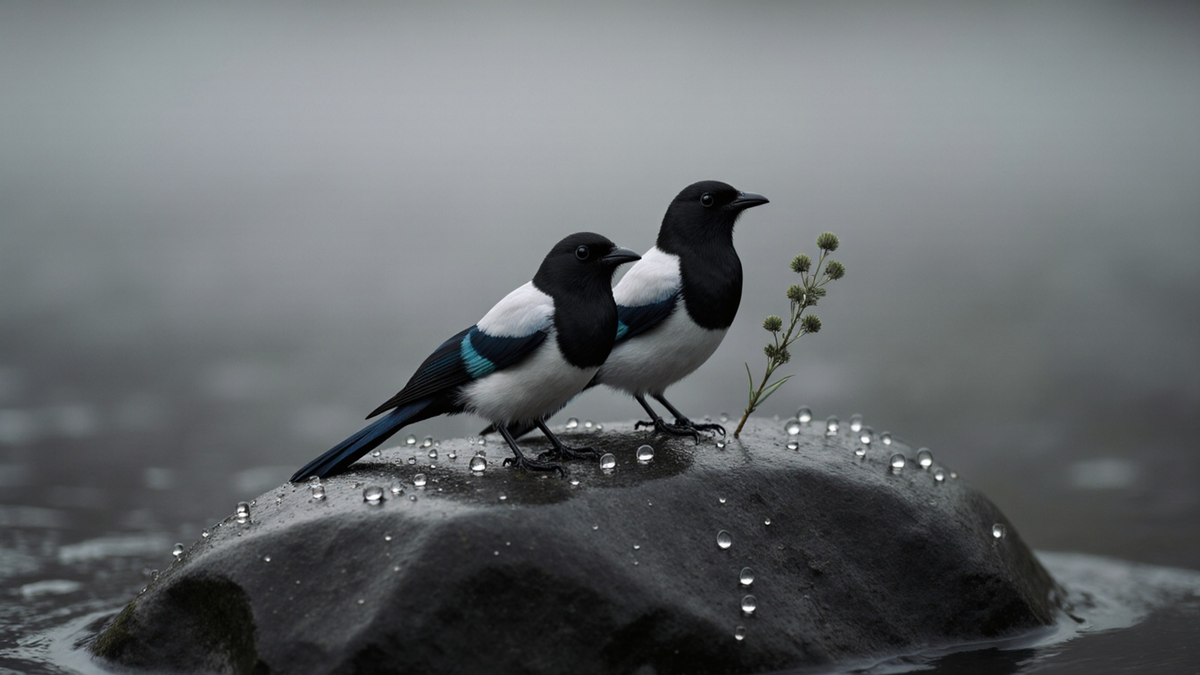
Moved by their sorrow, the magpies—known in Korean as kkachi (까치)—and the crows of the world would fly into the sky and join their wings together to form a bridge (ojakgyo, 오작교) across the Milky Way. This allowed the lovers to cross and reunite for one night. Legend holds that after this reunion, the birds are left with bald patches on their heads, the physical toll of having served as a path for the lovers.
The Seasonal Bridge: Farming and Rainfall
Unlike modern celebrations of romance, Chilseok has historically been a pragmatic observance deeply tied to the Korean agricultural calendar. In the traditional Korean countryside, the seventh lunar month falls during a critical window in the farming cycle.
The heat of summer is at its peak, and the fields are lush and green, but they are also nearing the end of their growth cycle before the autumn harvest. Traditionally, Chilseok marks the time when the heavy summer rains begin to taper off. A common folk belief states that the rain falling on the morning of Chilseok is the tears of joy shed by Gyeonwu and Jingnyeo upon their meeting, while the rain that falls the following evening is the tears of sorrow shed upon their departure.
Because of this, the day has long been associated with the conclusion of the summer weeding season. It is a moment of communal relief and preparation. Once the weeds are cleared and the Chilseok rains have watered the crops, the farming community can look forward to the approaching harvest. It is not uncommon to find references to Chilseok in historical accounts as a day for making offerings to the spirits of the fields, ensuring that the final push of the growing season remains productive.
Culinary and Domestic Traditions
In the context of the domestic sphere, Chilseok was traditionally a time for seasonal maintenance. As the summer humidity reaches its limit, the risk of mold and fabric damage in traditional households is high. Historically, families would air out their clothing, books, and household goods on this day, taking advantage of the clear skies to prevent decay before the arrival of autumn.
The culinary traditions of Chilseok are also deeply tied to the specific produce available at this time of year. Wheat is a primary component of Chilseok cuisine. Because wheat is said to lose its flavor after the first autumn frost, the days leading up to Chilseok are considered the final opportunity to enjoy it in its prime.
Miljeonbyeong (밀전병), a savory wheat pancake, and mil-guksu (밀국수), wheat noodle soup, are the standard dishes of the day. Families would prepare these wheat-based meals to honor the transition of the season, effectively “closing out” the wheat harvest before the focus shifted to the rice harvest in late autumn. The preparation of these foods was a way of aligning the home with the natural rhythms of the earth.
Observing Modern Traces
For the contemporary international observer, the nuances of Chilseok appear not in grand public parades, but in the subtle cultural markers of Korean life. When walking through a Korean marketplace in late summer, you may notice an abundance of wheat-based snacks or a sudden increase in the availability of seasonal produce that seems to vanish shortly thereafter.
In literature and media, the imagery of the magpie bridge is frequently employed to evoke feelings of longing, distance, and the inevitability of change. If you see a scene in a film or drama where characters are separated by a metaphorical distance, and a reference to “stars” or “magpies” is made, it is almost certainly a callback to this foundational myth. It is a way for Korean creators to signal a deep, enduring connection that persists despite geographic or social obstacles.
Understanding Chilseok provides a lens through which to view how the Korean calendar organizes daily life. It is not a day for commercial exchange or elaborate public declarations. Instead, it is a quiet, contemplative acknowledgement of the natural world. It is the act of recognizing that the cycle of the seasons—from the hard labor of summer to the preparation for the harvest—is mirrored in the narratives we tell about the stars above us.
When the rains come in late summer, and the air turns slightly cooler in the evenings, the story of the cowherd and the weaver serves as a reminder of the rhythm of the year. The magpie bridge does not just connect two stars; it connects the present moment to the long-standing observations of those who walked these fields centuries before. It is a tradition that asks its participants to look at the sky, note the date, and appreciate the fleeting nature of the season.