Hungbu and Nolbu: Karma & K-Drama
안녕, K-VIBERS! Are you ready to unravel a timeless tale that perfectly captures the heart and soul of Korean folklore? Today, we’re diving deep into one of Korea’s most beloved 전래동화 (traditional fairytales), a story that has been whispered through generations and continues to teach profound lessons: Hungbu and Nolbu. This isn’t just any fairytale; it’s a dramatic saga of good versus evil, sibling rivalry, and the mystical power of karma, all wrapped up in a captivating narrative that will make you smile, gasp, and reflect.
The story of Hungbu and Nolbu is a cornerstone of Korean cultural identity, a vivid narrative tapestry that beautifully illustrates the dramatic contrast between selfless kindness (선함) and insatiable greed (탐욕). It’s a tale that takes you on a journey through human nature’s extremes, all while introducing a whimsical, magical element – the swallow’s gratitude – that truly makes it unforgettable. Prepare to be enchanted by a story that’s not just ancient history, but a vibrant mirror reflecting universal truths relevant even today!
The Unforgettable Duo: Hungbu and Nolbu – A Tale of Two Brothers
At the heart of our story are two brothers, Hungbu and Nolbu, whose lives couldn’t be more different. Their stark contrast forms the very foundation of the tale, immediately drawing the reader into a world where moral choices have tangible, often spectacular, consequences. This initial setup is crucial for understanding the universal themes the 전래동화 aims to convey.
The Kind-Hearted Hungbu: A Symbol of Perseverance
Hungbu (흥부) is the younger brother, a figure synonymous with poverty (가난) and unwavering kindness. Despite facing immense hardship, struggling to feed his large family, Hungbu remains pure of heart. He is portrayed as hardworking, humble, and compassionate, embodying the traditional Korean virtues of resilience and benevolence. His home might be simple, his family’s stomachs often empty, but his spirit is rich with integrity and a genuine concern for others. He never complains about his fate, nor does he harbor ill will towards his more fortunate elder brother. His character is a testament to the idea that true wealth lies not in material possessions, but in one’s moral compass.
Hungbu’s struggles are often depicted in heartbreaking detail, allowing readers to deeply empathize with his plight. He toils tirelessly in the fields, yet the meager harvests barely sustain his family. His children often go hungry, a poignant detail that amplifies his suffering and, consequently, magnifies the impact of his eventual fortune. This depiction of Hungbu’s virtuous poverty is essential for the story’s dramatic arc, setting the stage for the miraculous turnaround that is to come. His unwavering goodness in the face of adversity is what makes him such a compelling and beloved character in Korean folklore.
The Greedy Nolbu: A Warning Against Avarice
In sharp contrast to Hungbu, we have Nolbu (놀부), the elder brother. Nolbu is wealthy (부자), having inherited the family fortune, but his heart is as cold as his coffers are full. He is the personification of selfishness and avarice, known for his harshness, stinginess, and cruelty, not just towards his own brother, but towards anyone he perceives as weaker or less fortunate. Nolbu refuses to help Hungbu, despite his brother’s desperate pleas, often mocking his poverty and turning him away empty-handed. His character serves as a stark warning against the corrupting influence of unchecked greed and self-interest.
Nolbu’s actions are often exaggerated to highlight his wickedness. He is depicted as someone who hoards his wealth, enjoys seeing others suffer, and takes pleasure in denying help to those in need. This extreme portrayal ensures that his character is clearly understood as the antagonist, leaving no room for ambiguity about his moral failings. His disdain for his own brother, a bond often considered sacred in Korean culture through the concept of 정 (jeong – a deep sense of affection/connection), is particularly shocking and underscores the depth of his malevolence. The narrative uses Nolbu not just as a foil to Hungbu, but as a cautionary tale, illustrating how wealth, when coupled with a lack of empathy, can lead to moral decay. The dynamic between Hungbu and Nolbu creates an immediate, visceral understanding of the story’s central conflict.
The Pivotal Moment: The Swallow’s Blessing and the Gourds of Destiny
The true magic of the Hungbu and Nolbu story unfolds with the introduction of a seemingly ordinary creature – a swallow (제비). This small bird acts as the catalyst for the supernatural events that dramatically alter the fortunes of both brothers, serving as a powerful symbol of divine intervention and the concept of 인과응보 (ingwa eungbo – karma or retribution).
Hungbu’s Act of Kindness: The Injured Swallow
One day, while working in his meager field, Hungbu discovers a young swallow with a broken leg. Unlike Nolbu, who would likely ignore or even harm the creature, Hungbu’s compassionate nature shines through. He carefully bandages the swallow’s tiny leg, nurses it back to health, and releases it when it’s strong enough to fly. This act of selfless kindness, devoid of any expectation of reward, is a pivotal moment in the narrative. It demonstrates Hungbu’s intrinsic goodness and his respect for all living things, a virtue deeply cherished in traditional Korean thought.
This simple act of mercy is not just a plot device; it’s a profound statement about the power of empathy and the ripple effect of good deeds. Hungbu doesn’t question why he should help a mere bird; he simply acts out of his inherent kindness. This scene beautifully sets up the idea that genuine benevolence, no matter how small the act, will ultimately be recognized and rewarded. The image of the struggling Hungbu and Nolbu with the injured swallow highlights the profound difference in their characters.
The Magical Gourd Seeds: A Miraculous Reward
The following spring, the swallow, now fully recovered, returns to Hungbu’s home. But it doesn’t come empty-handed. In its beak, it carries a small seed, which it drops into Hungbu’s yard. Hungbu, ever the diligent farmer, plants the seed, not knowing the extraordinary harvest it will yield. To his astonishment, the seed quickly grows into a magnificent vine, bearing enormous gourds (박). These aren’t ordinary gourds; they are gourds of destiny.
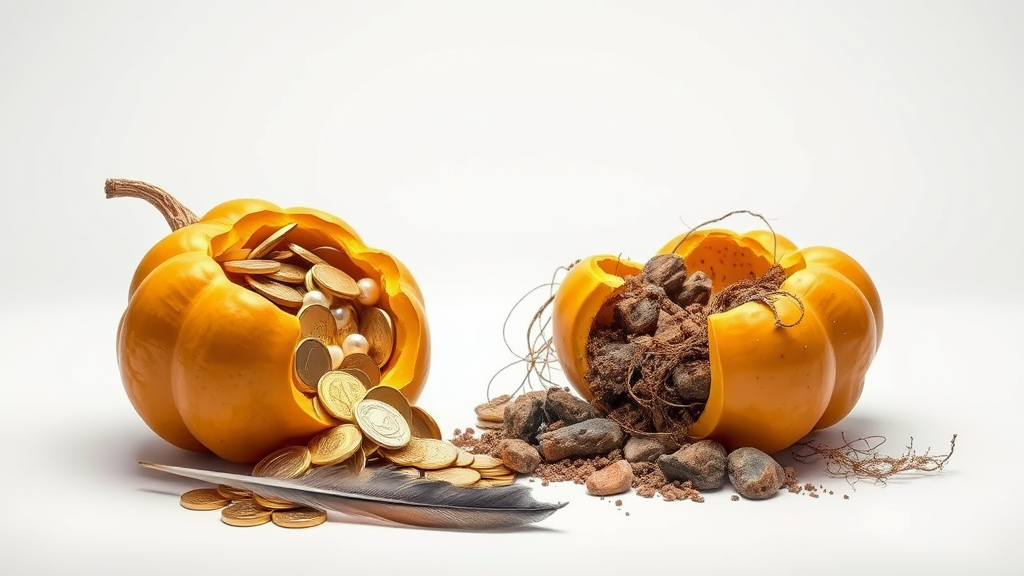
When Hungbu and his family cut open the gourds, they discover a wondrous surprise. Instead of pulp and seeds, the gourds are filled with an abundance of treasures: gleaming gold, sparkling jewels, precious silks, and even magical servants who appear to help build a grand new house and fill it with food. In an instant, Hungbu’s long-suffering poverty is transformed into unimaginable wealth and comfort. This miraculous transformation is the direct result of his earlier act of kindness, a clear manifestation of the 제비 은혜 (jebi eunhye – the swallow’s gratitude or blessing). The image of Hungbu and Nolbu receiving their distinct destinies makes the moral perfectly clear.
The Fateful Imitation: Nolbu’s Greed and Its Bitter Harvest
News of Hungbu’s sudden fortune inevitably reaches Nolbu. Consumed by envy and his characteristic 탐욕 (greed), Nolbu decides he must replicate his brother’s success. He doesn’t understand that Hungbu’s reward stemmed from genuine kindness; he only sees the method and attempts to mimic it with malicious intent. This section of the Hungbu and Nolbu tale is where the dramatic irony and the full force of the story’s moral come crashing down.
Nolbu’s Cruel Deception: Feigned Kindness
Driven by his insatiable desire for more wealth, Nolbu actively seeks out an injured swallow. Unlike Hungbu, who stumbled upon a wounded bird by chance and acted out of pure compassion, Nolbu deliberately injures a swallow himself, or finds one and then feigns concern. He meticulously bandages its leg, mimicking Hungbu’s actions, but his heart is devoid of any true kindness. His motive is purely selfish: to receive the magical gourd seeds and become even richer. This calculated deception highlights the superficiality of his actions and underscores the vast moral chasm between the two brothers.
Nolbu’s attempt to artificially create the circumstances for a reward exposes his fundamental misunderstanding of the universe’s workings in this 전래동화. He believes that merely performing the actions will yield the same result, failing to grasp that it is the purity of intent that truly matters. This scene is critical in demonstrating that genuine virtue cannot be faked or bought; it must come from within. The contrast between the genuine suffering of the swallow in Hungbu’s care and the contrived injury in Nolbu’s is chilling and powerful.
The Gourds of Retribution: A Karmic Downfall
Just as with Hungbu, the swallow (or perhaps another swallow) eventually returns to Nolbu with a seed. Nolbu plants it, and again, enormous gourds grow. His heart pounding with anticipation, he eagerly cuts them open, expecting even greater treasures than his brother received. However, instead of gold and jewels, Nolbu’s gourds unleash a horrifying array of punishments.
From one gourd tumble out 도깨비 (dokkaebi – goblin-like creatures) or mischievous spirits who torment him and destroy his property. From another, venomous snakes and scorpions emerge, terrorizing his family. Yet another gourd might reveal torrents of water, washing away his home, or swarms of angry bees. Each gourd brings a different form of misfortune and misery, stripping Nolbu of his ill-gotten wealth and leaving him in utter ruin, far poorer than Hungbu ever was. This spectacular downfall is the ultimate manifestation of 인과응보, a vivid demonstration that evil deeds, especially those stemming from greed and cruelty, will inevitably lead to dire consequences. The tale of Hungbu and Nolbu reaches its climax here, delivering a satisfying sense of justice.
Beyond the Fairytale: Universal Lessons from Hungbu and Nolbu
The story of Hungbu and Nolbu is far more than just an entertaining narrative; it’s a rich tapestry of profound universal lessons that transcend cultural boundaries and remain relevant in the modern world. Its dramatic contrast between virtue and vice, magical realism, and relatable human emotions make it a powerful vehicle for moral education.
The Timeless Power of Kindness and Compassion
The most prominent lesson from Hungbu and Nolbu is the enduring power of kindness (선함) and compassion. Hungbu’s selfless act towards the injured swallow, performed without expectation of reward, ultimately transforms his life from poverty to prosperity. This reinforces the idea that true generosity of spirit is its own reward, and often, it brings unexpected blessings. The story teaches children and adults alike that being kind, empathetic, and helpful to others, regardless of their status or species, is a fundamental virtue.
In a world often driven by self-interest and competition, the tale of Hungbu and Nolbu serves as a vital reminder that acts of genuine goodness can create positive ripples, even if the reward isn’t immediate or tangible. It encourages a deeper sense of humanity and interconnectedness, advocating for a society where individuals look out for one another and treat all living beings with respect. This simple yet profound message resonates deeply across all cultures and generations, making Hungbu and Nolbu a truly timeless narrative.
The Destructive Nature of Greed and Envy
Conversely, Nolbu’s character is a stark cautionary tale about the destructive nature of greed (탐욕) and envy. His insatiable desire for wealth, his cruelty towards his own brother, and his attempt to manipulate fate through feigned kindness lead to his catastrophic downfall. The story powerfully illustrates how unchecked avarice can corrupt the soul, blind individuals to their moral duties, and ultimately lead to suffering and ruin. Nolbu’s tragic end is a clear message that wealth acquired through unjust means or pursued with selfish intent will never bring true happiness or lasting prosperity.
The fable highlights how envy can poison relationships, turning siblings against each other and dissolving the bonds of 정 (jeong – deep affection/connection) that are so important in Korean society. Nolbu’s inability to rejoice in his brother’s good fortune, coupled with his desperate attempt to replicate it through deceit, underscores the spiritual poverty that often accompanies material wealth when it is not balanced by virtue. The suffering he experiences is a direct consequence of his character flaws, reinforcing the concept of 인과응보 (karma or retribution). The narrative of Hungbu and Nolbu serves as a powerful deterrent against these negative traits, encouraging humility and contentment.
Sibling Rivalry and Filial Piety: Beyond the Supernatural
While the swallow and magic gourds add a fantastical element, the core conflict of Hungbu and Nolbu is rooted in the very real and universal human experience of sibling rivalry. The story explores the painful dynamics that can arise within families when compassion is absent and material possessions overshadow familial bonds. Nolbu’s cruel treatment of Hungbu is a stark portrayal of how greed can sever even the strongest ties of brotherhood.
On the flip side, Hungbu’s unwavering spirit and his dedication to his family, even in extreme poverty, can be seen as an expression of 효도 (hyodo – filial piety and familial devotion) in a broader sense, focusing on his responsibility as a family head. The story subtly suggests that the ideal family values involve mutual support, love, and respect, rather than competition and neglect. By weaving this realistic theme of sibling conflict into a supernatural narrative, the tale speaks to the complexities of human relationships, offering a moral compass for navigating family dynamics. The lessons from Hungbu and Nolbu extend beyond just personal morality, touching upon societal harmony.
The Role of Divine Justice and Karma
The magical intervention of the swallow is not just a whimsical plot device; it serves as a powerful metaphor for divine justice or the cosmic law of karma (인과응보). The swallow, acting as an agent of retribution, ensures that good deeds are rewarded and evil deeds are punished. This element reassures the audience that ultimately, the universe balances the scales, and that moral integrity will prevail. It instills hope that suffering endured with kindness will be recognized, and that malice, no matter how clever, will face its just deserts.
This aspect of Hungbu and Nolbu provides a sense of order and fairness in a world that often seems arbitrary. It teaches that one’s actions have consequences, even if they are not immediately apparent, and encourages individuals to act righteously, knowing that their moral choices have an impact far beyond their immediate perception. This belief in a higher justice or the power of karma is a concept found in many cultures, making the story of Hungbu and Nolbu accessible and relatable to international audiences.
Conclusion: Embrace the K-VIBE of Kindness!
The fairytale of Hungbu and Nolbu is a shining example of how traditional stories can transcend time and culture, delivering universal truths with engaging storytelling. It’s a tale that teaches us to value kindness over riches, compassion over cruelty, and integrity over greed. Through the dramatic contrast of the two brothers and the magical intervention of the swallow, it reminds us that true wealth lies in the purity of our hearts and the goodness of our actions.
So, the next time you hear about a stroke of good fortune or an unexpected downfall, you might just recall the story of Hungbu and Nolbu and the powerful lessons embedded within its narrative. It’s a reminder that even in our modern, fast-paced world, the simple virtues of 선함 (goodness) and 은혜 (gratitude) remain our most precious treasures.
What are your thoughts on Hungbu and Nolbu? Have you heard this story before, or does it remind you of fairytales from your own culture? Share your favorite lesson from this tale in the comments below! And don’t forget to spread some K-VIBE kindness today!