Heungbu and Nolbu: Generosity, Envy, and Social Mobility
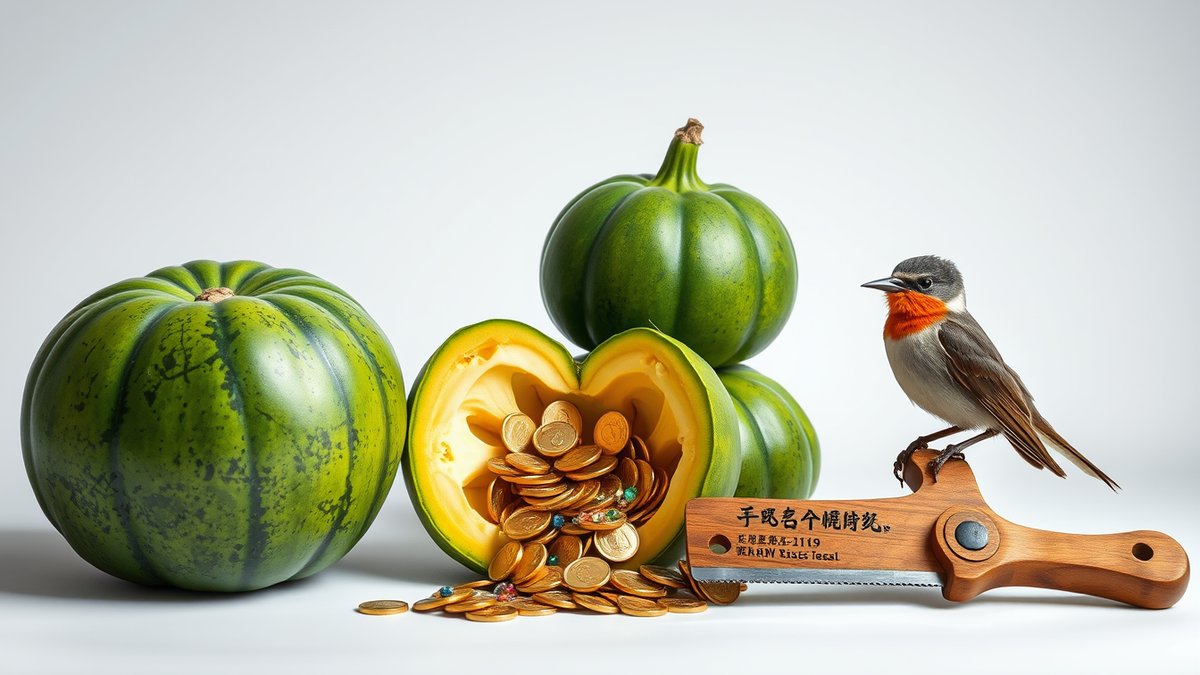
The story of Heungbu and Nolbu (흥부와 놀부) is arguably the most famous folk tale in Korean history, serving as a cornerstone of the nation’s moral education for centuries. While children in the West grow up with the sibling rivalries of Cinderella or the karmic lessons of Aesop’s fables, every Korean child grows up hearing the rhythmic sawing of a giant gourd and the miraculous flight of a broken-winged swallow.
But to view this story merely as a “be kind to animals” nursery rhyme is to miss the profound socio-economic commentary hidden beneath its surface. At its heart, Heungbu and Nolbu is a narrative about the shifting tides of wealth, the weight of Confucian family obligations, and the eternal Korean struggle for social mobility. In an era where “K-class” dynamics are explored in films like Parasite or series like Squid Game, looking back at this ancient tale reveals that Korea’s preoccupation with fairness and the “Golden Spoon” vs. “Dirt Spoon” divide is anything but new.
The Tale of Two Brothers: A Study in Contrast
To understand the cultural resonance of the story, we must first look at the characters who represent the polar opposites of the human condition. The tale is traditionally told through Pansori (판소리), a form of traditional Korean musical storytelling where a solo singer and a drummer narrate long epics. This oral tradition ensured that the emotional highs and lows of the brothers’ lives were felt deeply by the common people.
The Greed of Nolbu
Nolbu, the elder brother, is the quintessential villain of Korean folklore. Upon the death of their father, Nolbu seizes the entire family inheritance, effectively casting his younger brother, Heungbu, out into the cold. In the context of the Joseon Dynasty, this was not just a personal mean streak; it was a violation of the spirit of U-ae (우애), the deep brotherly love and mutual support expected in a Confucian society. Nolbu represents the “haves” who refuse to share, characterized by his insatiable greed and his lack of In (인), or benevolence. He is wealthy, well-fed, and entirely indifferent to the suffering of his own blood.
The Poverty of Heungbu
In stark contrast, Heungbu is the “Dirt Spoon” (Heuk-su-jeo / 흑수저) of his time. Despite his relentless hard work and his unwavering kindness, he remains desperately poor. He has a large family to feed—often depicted as having a dozen or more children—and no land to till. Heungbu’s character is defined by In-nae (인내), the virtue of endurance. He does not harbor resentment toward his brother; instead, he accepts his lot in life with a gentle heart. Heungbu represents the commoner’s plight: working within a system that seems rigged against the virtuous.
The Swallow and the Gourd
The turning point of the story occurs when Heungbu finds a swallow (Jebi / 제비) with a broken leg, injured by a predatory snake. He treats the bird with tender care, binding its leg and nursing it back to health. To repay his Eun-hye (은혜)—a debt of gratitude or a favor that must be returned—the swallow returns the following spring with a magic seed. Heungbu plants it, and a giant gourd (Bak / 박) grows. When he and his wife saw the gourd open, they don’t find seeds, but gold, silver, and a magnificent palace.
Nolbu, hearing of this, deliberately breaks a swallow’s leg just so he can “fix” it and get his own seed. However, his gourds do not contain treasure. Instead, they unleash goblins (Dokkaebi / 도깨비), debt collectors, and floods of filth that strip him of his stolen wealth.
The Moral Compass of Joseon: Confucianism and Karma
While the story provides a satisfying “happily ever after,” the cultural underpinnings are deeply rooted in the philosophy of the Joseon era. The tale functions as a manual for Gwon-seon-jing-ak (권선징악), a four-character idiom that translates to “promoting good and punishing evil.”
The Weight of Filial Piety and Brotherhood
In traditional Korean society, Hyo (효), or filial piety, extends beyond parents to the entire family hierarchy. The eldest son held the most power but also the most responsibility. By kicking Heungbu out, Nolbu wasn’t just being a “bad brother”; he was failing his duty as the head of the household. The story serves as a warning to those in power: wealth is a communal trust, not a personal prize. For international readers, this mirrors the themes in Shakespeare’s King Lear, where the betrayal of family bonds leads to total societal collapse.
The Concept of Heung (흥)
There is a specific Korean quality called Heung (흥)—an irrepressible sense of joy, rhythm, and spirit. Despite his poverty, Heungbu is often depicted as having Heung. He sings, he remains hopeful, and he maintains his humanity. In the Korean worldview, Heung is what allows a person to survive the most difficult circumstances without becoming bitter. The story suggests that Nolbu, despite his riches, lacks this spirit because his heart is cramped by envy. This internal state eventually dictates their external fates.
Supernatural Justice
Unlike Western tales where a fairy godmother might intervene, the “justice” in Heungbu and Nolbu is delivered through nature and the supernatural. The swallow acts as an emissary of a higher moral order. In Korea, birds like swallows and magpies are often seen as omens of good news. The fact that a small, fragile creature brings about the downfall of a powerful man suggests that no one is too small to be an instrument of fate. It reinforces the idea that the universe keeps a ledger of one’s intentions, not just their actions.
Social Mobility: The Dream of the “Jackpot”
If we look at the story through a modern lens, the magic gourd represents the ultimate fantasy of social mobility. In a rigid class society where commoners had little hope of changing their status, the “magic seed” was the 18th-century equivalent of winning the lottery or a startup going public.
The Agrarian Jackpot
For a Joseon peasant, land and grain were the only true forms of wealth. The gourd itself is a brilliant symbol. It is a humble vegetable, used for making bowls and tools in every household. By making the source of Heungbu’s wealth a common gourd rather than a hidden treasure chest or a king’s decree, the story suggests that prosperity can bloom from the most ordinary places if the “seed” (the intent) is pure.
The Envy of the “Nolbu” Class
Nolbu’s reaction to Heungbu’s success is a perfect study of Sigi (시기), or envy. In modern Korea, there is a saying: “If my cousin buys land, I get a stomachache.” This speaks to the intense competition and social comparison that exists in a densely populated, status-conscious society. Nolbu cannot stand to see his brother rise, not because he needs more money, but because his brother’s success threatens his sense of superiority. This “stomachache” leads to his reckless attempt to mimic Heungbu’s actions, proving that greed lacks the “heart” necessary for true success.
From Dirt Spoon to Gold Spoon
Today, young Koreans use the “Spoon Theory” to describe their social standing. A “Gold Spoon” (Geum-su-jeo) is someone born into wealth, while a “Dirt Spoon” (Heuk-su-jeo) is someone like Heungbu. The tale remains popular because it provides a cathartic release for the “Dirt Spoons.” It promises that even in a world where the “Gold Spoons” (Nolbus) control all the resources, a moment of genuine kindness or a stroke of “heavenly luck” can flip the script. It is the original “Rags to Riches” K-Drama plot.
Global Comparisons and Modern Relevance
To international readers, the themes of Heungbu and Nolbu may feel familiar, yet uniquely Korean in their execution.
Comparing with Western Folklore
The story shares DNA with the Grimm brothers’ Mother Holle or the French tale Diamonds and Toads, where one sister is rewarded with jewels for her kindness and the other is cursed with toads for her rudeness. However, the Korean version focuses heavily on the familial unit. In Western tales, the protagonist often leaves home to find their fortune. In Heungbu and Nolbu, the resolution isn’t Heungbu moving away to a far-off kingdom; it is Heungbu forgiving Nolbu and bringing him back into the family fold. The story ends with a restoration of the family unit, which is the ultimate “win” in Korean culture.
Heungbu and Nolbu in Pop Culture
You can see the shadows of this tale in various aspects of modern Korean media:
- Variety Shows: Often, the “mean” character and the “kind/clumsy” character in variety show pairings are compared to Nolbu and Heungbu.
- K-Dramas: The “evil chaebol” who hoards wealth and the “poor but hardworking protagonist” is the modern iteration of this dynamic.
- Business: The term “Nolbu” is even used in branding (such as the famous restaurant chain Nolbu Budae Jjigae), though there it focuses more on the “big appetite” and “abundance” aspect of his character rather than his villainy.
Lessons for the 21st Century
The most poignant part of the story’s conclusion is that Heungbu does not let Nolbu starve. After the goblins ruin Nolbu, Heungbu shares his new wealth with his brother. This is the final lesson: the goal of success isn’t just to surpass your enemies, but to have enough to be generous even to those who wronged you. In an era of increasing social isolation and “winner-takes-all” economics, this emphasis on communal restoration is a powerful reminder of the value of Jeong (정)—the deep, lingering feeling of attachment and empathy that binds Koreans together.
Conclusion: Why the Sawing Continues
The story of Heungbu and Nolbu continues to be retold because it addresses the fundamental anxieties of the human experience: the fear of poverty, the sting of injustice, and the hope that goodness is eventually recognized. It tells us that while greed might provide a temporary “Golden Spoon,” it is the enduring spirit of Heung and the willingness to help even the smallest creature that leads to true, sustainable prosperity.
Next time you see a swallow in the spring or see a decorative gourd in a Korean traditional village (Hanok Maeul), remember the two brothers. Ask yourself: in a world full of Nolbus, do I have the courage to be a Heungbu?
What do you think of Heungbu’s decision to forgive his brother? Would you have shared your “gourd treasure” with someone who kicked you out? Let us know in the comments below!
Sources and further reading:
- The National Folk Museum of Korea: Encyclopedia of Korean Folk Literature. A comprehensive resource on the origins and variations of the Heungbu tale.
- Academy of Korean Studies (AKS): The Digital Encyclopedia of Korean Culture. Provides historical context on Joseon-era inheritance laws and social structures.
- Korea Net (Official Gateway to Korea): Korean Heritage: Folk Tales. Offers insights into the cultural symbols like the swallow and the gourd.
- Literature Translation Institute of Korea (LTI Korea): Anthology of Korean Traditional Literature. For those looking to read the translated Pansori scripts of the story.